


Introduction
To begin with, I’d like to share my experience with impostor syndrome because, for a long time (and even now, at times), I didn’t feel entitled to say out loud that I was going through it.
As a child, the education system taught me to measure my worth through grades. Since my grades weren’t always good, I ended up believing I wasn’t enough. That idea became part of my identity: “Don’t ask me, I don’t know anything,” “What do you expect from me? I’m not smart.” I used to say it jokingly… until it stopped being a joke.
For years, I carried those beliefs, which shaped my self-esteem. However, some people kept insisting that I had something to contribute.
When I first came across the term “impostor syndrome,” I felt relief: finally, what I was experiencing had a name. But almost immediately, another thought crept in: “Impostor syndrome means that, deep down, I have something valuable to offer… what if that’s not true in my case?” I didn’t even feel worthy of having it.
This blog was born from the need to put into words what it means to doubt yourself to the point of discrediting all your achievements. It’s also about what I’ve learned along the way: when we can’t trust our own perception, we can lean on the people around us. If someone gave you an opportunity, a promotion, or a new challenge, it wasn’t by chance. You’re here because you have a path that supports you. Be kinder to yourself: it’s not luck, it’s your value that brought you here.
Having the chance to share my experience with others led me to research and discover that I wasn’t alone; that what I was feeling had an explanation, and that psychology had even coined a term to describe it.
Understanding it and truly internalizing it brought me relief and helped me recognize that behind these doubts, there are patterns that repeat themselves in countless people. That’s why, before talking about tools to face it, I want to pause on the essentials: what it is, how it arises, and the ways it usually manifests.
1. Definition
Impostor syndrome was first described in 1978 by Drs. Pauline Clance and Suzanne Imes. Initially, it was mainly associated with women, but today we know it also affects men. The difference is that, in women, it is often reinforced by social and cultural expectations.
This psychological phenomenon is characterized by the belief that our achievements result from luck rather than our abilities. We live with the feeling that at any moment someone will discover that “we don’t know as much as it seems.” We don’t feel deserving of our success, and in competitive environments such as work or university, insecurity intensifies.
Although it’s not considered an illness, around 70% of people experience it at some point. What’s curious is that even when we see that others experience it too, we still believe we’re the only “real” impostors. And no matter how outstanding your achievements or recognition may be, from Albert Einstein to Emma Watson or Michelle Obama, many have spoken about that same feeling of being a fraud.
Albert Einstein – “The exaggerated esteem in which my life’s work is held makes me feel very ill at ease. I feel compelled to think of myself as an involuntary swindler.”
Emma Watson – “Any moment, someone is going to find out that I’m a fraud and that I don’t belong here.”
Michelle Obama has admitted that “At times, she feels like she shouldn’t be where she is.”
2. Profile types and common expressions
Impostor syndrome doesn’t manifest in just one way. Different profiles share the same root: feeling inadequate.
- The Perfectionist – Always finds something that could have been done better and is rarely satisfied.
- The Superhuman – Takes on excessive responsibilities to “prove” their worth.
- The Natural Genius – Believes everything should come easily and gets frustrated when it doesn’t.
- The Individualist – Avoids asking for help out of fear of showing weakness.
- The Expert – Never feels prepared enough, even with extensive knowledge.
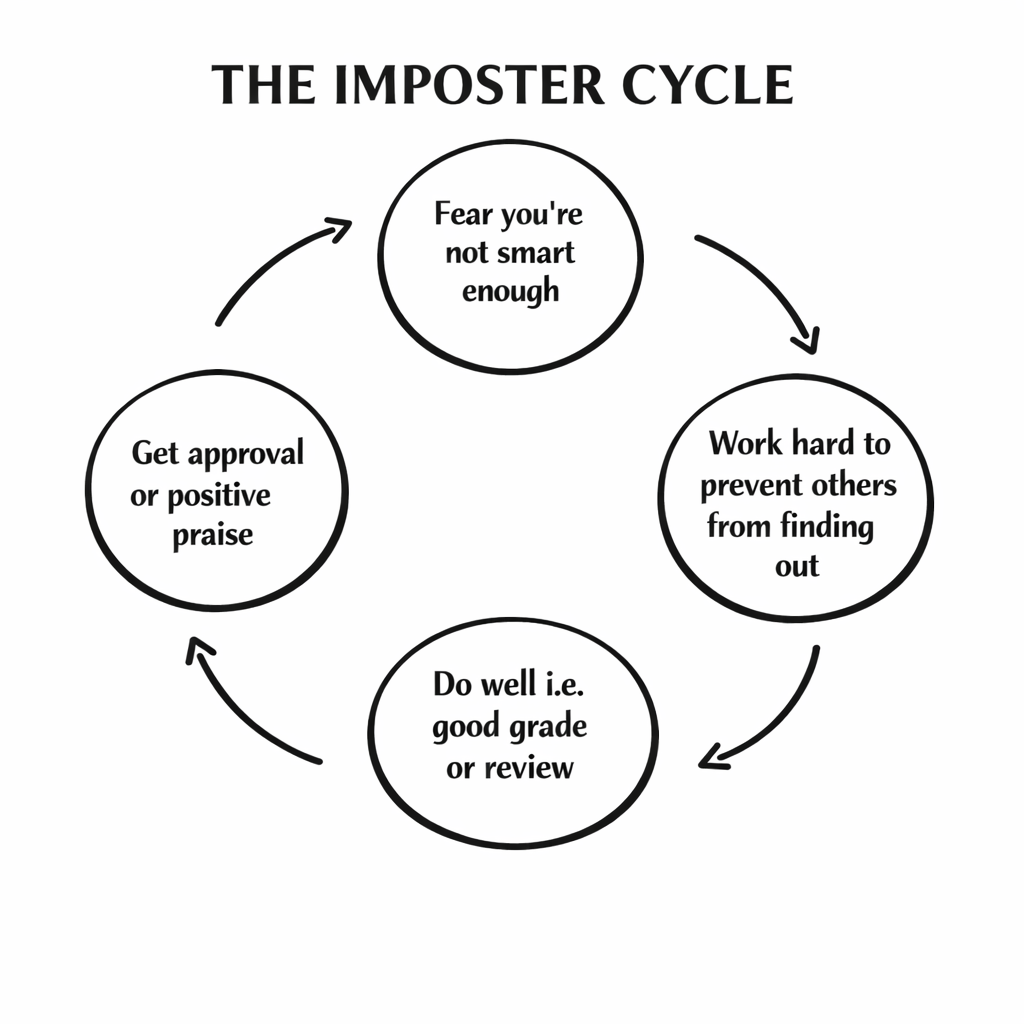
In some cases, this experience can become dysfunctional and seriously affect personal and professional life. Extreme self-demands can lead to procrastination, anxiety, insomnia, or fatigue. That’s why becoming aware of the cycle is key to breaking it.
Common expressions
- Feeling like a fraud – “They’re going to find me out”
- Chronic self-doubt – “I’m doing this wrong”
- Difficulty accepting praise or evidence of competence – “They don’t really mean it”
- Harsh self-criticism – “I’m not good enough”
- Living in fear – “I won’t meet expectations”
3. Tools to Face It
-
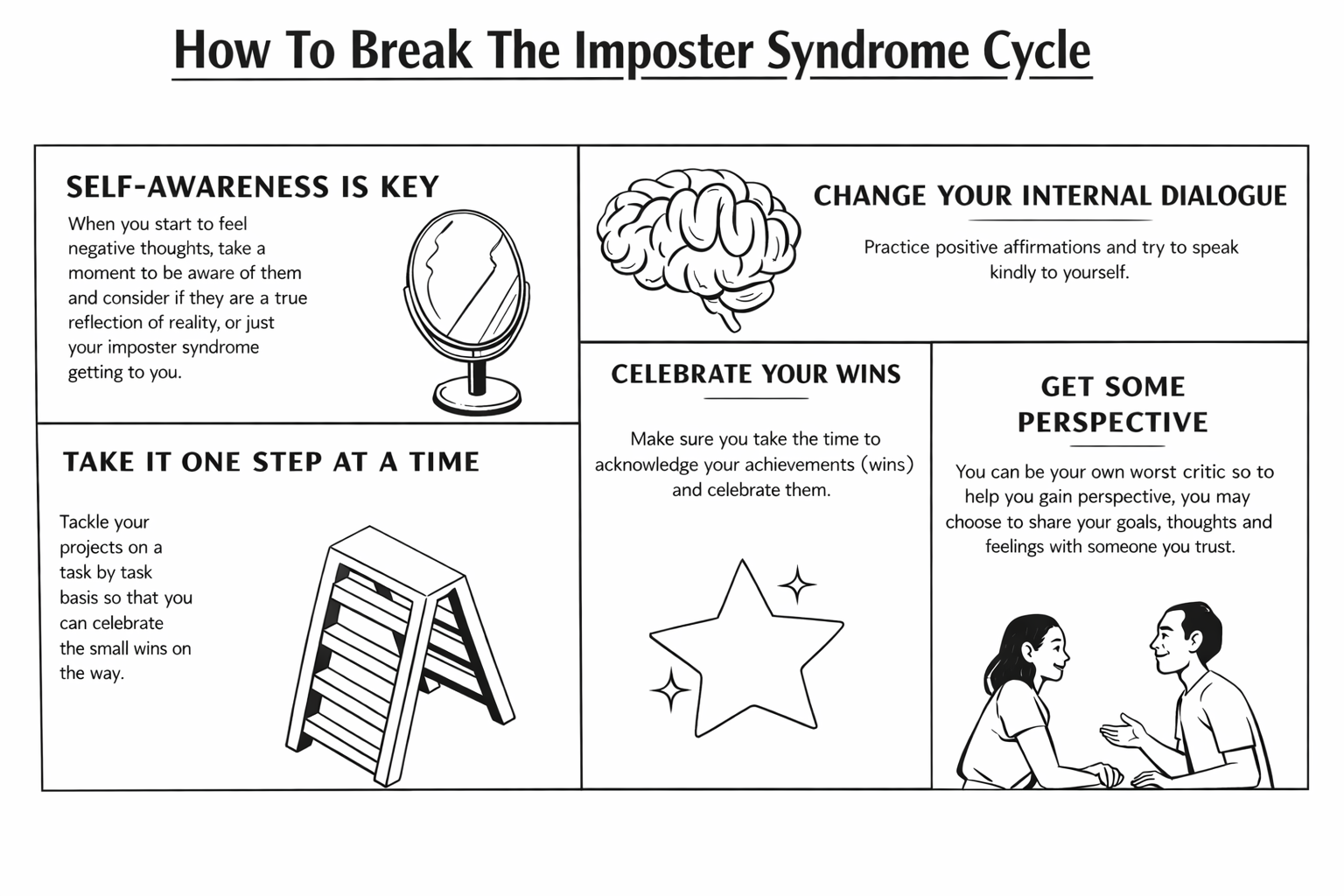
Normalize the experience
Acknowledge that you’re not alone. Talking about it with colleagues or friends helps take some of its weight off.
-
Question your thoughts
Identify whether what you’re feeling is based on facts or on fears. Remember that if you’ve made it this far, it wasn’t by chance; you went through processes and challenges to get here.
-
Change the way you act.
Celebrate your achievements, accept that you don’t need to be an expert in everything, and avoid self-sabotage.
-
Practice self-awareness
Identify which attitudes feed the “impostor” and replace them with more realistic thoughts.
Letting go of the impostor begins with an act of courage: believing in yourself. The first person who needs to recognize your worth is you, and that confidence directly impacts how you feel and how you work. When you doubt your place, it’s easy to stay silent, hold back ideas, or pass on challenges out of fear of “not being good enough.”
The truth is, no one gets where they are by accident. Your voice, your ideas, and your way of doing things matter. Don’t hold them back; trusting yourself is how you make room for your own growth.
